
2027 trends to watch: Distributed care will drive the next phase of healthcare delivery
Sep 17th, 2026

Healthcare delivery has never been confined to a single setting. But the number of places where patients can receive care, and the range of services available outside the hospital, have grown in recent years.
Today, a single patient journey might include a primary care visit, diagnostic imaging at an outpatient center, a procedure at an ambulatory surgery center (ASC), a virtual follow-up, and remote monitoring from home. Hospitals remain essential for acute and complex care, but they are increasingly one part of a broader network that spans physician offices, retail clinics, specialty facilities, virtual channels, and patients’ homes.
This more distributed model of healthcare delivery is being shaped by several forces at once, from advances in medical technology and economic pressures to workforce shortages and more. But distributed care also creates new complexity for healthcare providers and the organizations that support them. For companies looking to navigate these industry shifts and grow, success will depend on having the data and visibility to understand how the puzzle pieces of healthcare fit together.
Why healthcare is becoming more distributed
Some of the reasons behind the growing popularity of distributed care are:
- More care can happen outside the hospital
- Leaders are financially pressured to lower the costs of care
- Technology is expanding the boundaries of where care can happen
- Patient needs and demographics are reshaping care delivery
- The healthcare workforce is evolving
More care can happen outside the hospital
More surgeries and services are moving from inpatient hospitals to ASCs, hospital outpatient departments, and other community-based sites. Outpatient care is “in,” as more than 65% of surgeries in the U.S. are performed in outpatient settings, according to a 2026 study from The Leonard Davis Institute of Health Economics.
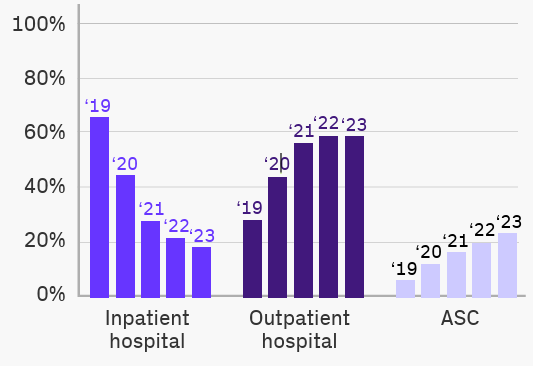
Definitive Healthcare data reinforces this trend. From 2019 to 2023, the share of knee surgeries performed in inpatient hospitals declined as more procedures moved into hospital outpatient departments and ambulatory surgery centers (ASCs).
Share of Inpatient, Outpatient, and ASC Knee Surgeries, 2019 - 2023
Part of that movement is being driven by improvements in how surgery is performed. Minimally invasive techniques, advances in anesthesia, and better postoperative care have shortened recovery times and made outpatient treatment appropriate for procedures that once routinely required hospitalization.
Recent policy is also contributing to this shift. In 2026, CMS began a three-year phaseout of its Inpatient Only (IPO) list, which historically limited Medicare reimbursement for certain procedures to the inpatient hospital setting. It removed 285 procedures, mostly musculoskeletal, from the list in the first year. Gradually, more services will be eligible for reimbursement in hospital outpatient departments and, where approved on the ASC Covered Procedures List, in ASCs. This creates significant growth opportunities for surgery centers that have the clinical staff and capacity to support more complex procedures.
Leaders are financially pressured to lower the costs of care
No surprise here: healthcare is expensive, and the cost of delivering it continues to rise.
According to the CMS, the U.S. spent nearly $5.3 trillion on healthcare in 2024, or more than $15,000 per person. And spending is expected to keep climbing, driven by a combination of pressures across the industry like inflation, supply chain inefficiencies, data breaches, and high administrative costs associated with billing. Prescription drugs are also a contributor to the U.S.’ high spending, accounting for $467 billion in health expenditures in 2024. GLP-1s are one striking example, totaling about 14% of all U.S. prescription drug spending in 2025, according to the American Society of Health-System Pharmacists.
Chronic and mental health conditions also represent an enormous share of healthcare utilization and cost: 90% of the nation’s $5.3 trillion in annual healthcare expenditures is spent on people with these conditions.
At the same time costs are rising, providers could face greater pressure on the other side of the balance sheet. The expiration of enhanced Affordable Care Act subsidies and new Medicaid eligibility requirements introduced by the OBBBA are expected to leave millions of Americans without health insurance in the years ahead, potentially leading to more uncompensated care. The phase out of CMS’ IPO list may also result in a rapid expansion of outpatient and ambulatory care, straining financial margins further as fewer procedures, especially those that are considerable revenue engines, take place in inpatient facilities.
Against that backdrop, healthcare leaders have strong incentives to consider moving into lower-cost settings whenever possible. A more distributed network can give patients additional ways to access routine, preventive, and lower-acuity care earlier—before an untreated condition progresses to the point that it requires a more intensive and costly intervention.
Technology is expanding the boundaries of where care can happen
Technology is giving providers new ways to extend care beyond traditional facilities while helping increasingly distributed networks to serve patients and operate more efficiently.
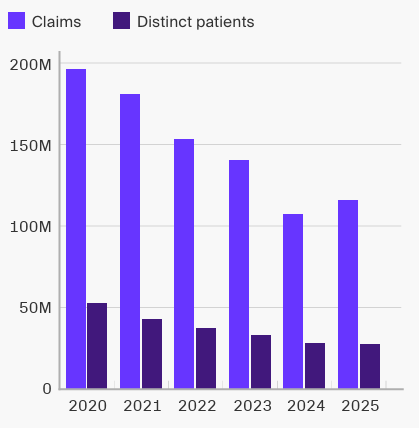
Telehealth is perhaps the clearest example, allowing organizations to broaden the reach of providers and connect patients with services that may not be readily available in their immediate communities. Understandably, however, our data shows that telehealth utilization has fallen from its pandemic-era peak. Since 2020, telehealth claims declined 41%, while the number of distinct patients using the technology fell 48%.
Telehealth Usage 2020 - 2025
But utilization remains strong for services that lend themselves well to virtual delivery, such as behavioral healthcare. According to FAIR Health, behavioral health conditions accounted for nearly 60% of all U.S. telehealth claims from January through March 2025.
Diagnoses With The Highest Share Of Telehealth-Related Claims
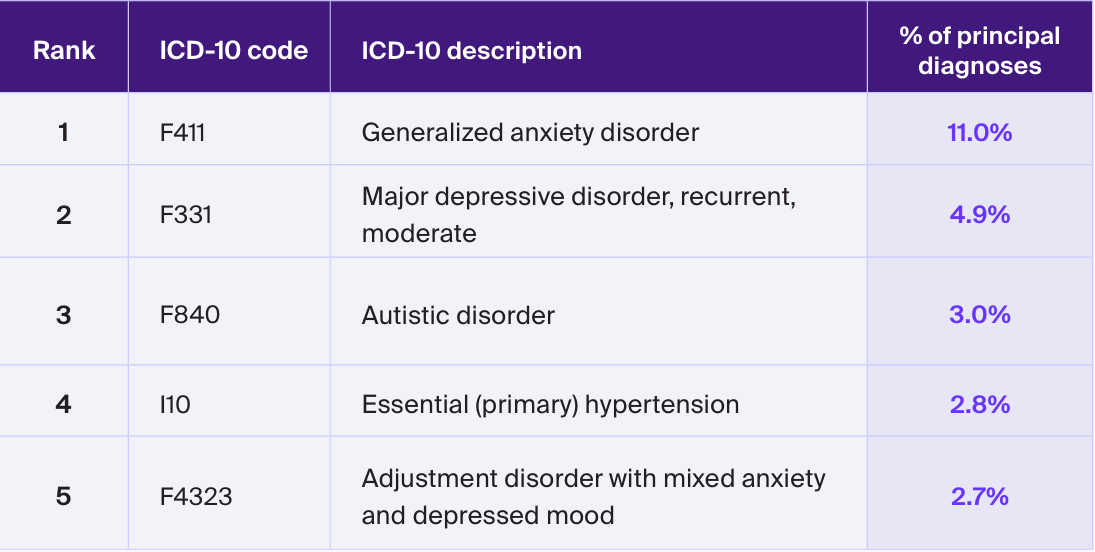
Atlas All-Payor Claims data reinforces this trend, with the top five telehealth diagnoses of 2025 including mental, behavioral, and neurodevelopmental health conditions.
Remote patient monitoring (RPM) takes the concept of distributed care further, turning the patient’s home into a part of the care network. Connected devices can transmit information such as blood pressure, glucose levels, weight, heart rate, and other health indicators from a patient’s home to their care team, enabling regular visibility into a patient between encounters and allowing for earlier interventions if needed. According to the HHS Office of Inspector General, nearly 1 million Medicare enrollees received RPM services in 2024, up 27% from the year before. The continuous connection RPM tools provide can also help keep patients from returning to the hospital. A 2025 meta-analysis of 39 studies involving more than 160,000 recently discharged patients found that remote monitoring was associated with a 25% lower risk of all-cause readmission.
As telehealth and RPM tools make distributed care models more of a reality, they also present new opportunities for healthcare leaders to expand access into new markets or regions and adopt technologies that help them use clinical capacity more efficiently while improving the patient experience. But reaching these patients requires knowing where they are and how they move through the health system.
Patient needs and demographics are reshaping care delivery
Patient expectations are also influencing the shift toward distributed care.
For starters, the U.S. population is getting older and living longer, with the number of adults aged 65 and older continuing to rise. According to the U.S. Census Bureau, the 65+ population exceeded 61 million in 2024, up 13% from 2020.
At the same time, chronic disease is creating sustained demand for care across generations. CDC research found that more than 194 million U.S. adults reported having at least one chronic condition in 2026. And chronic illness is becoming increasingly common among younger adults, too: nearly 6 in 10 adults aged 18 to 34 now live with at least one chronic condition.
Together, these trends suggest that healthcare organizations are serving (or will need to serve) more patients who require recurring touchpoints, specialty care, ongoing monitoring, and coordination across multiple providers and settings.
But patients are also raising their standards when it comes to choosing who provides them with care and where they receive it. For many patients, convenience is king. A 2026 Tebra survey found that 68% of respondents would consider choosing a doctor who offered 24/7 online booking, while 57% preferred digital check-in or pre-visit forms. Another 2026 survey from Software Finder suggested that 35% of respondents would consider switching doctors because of a poor digital experience.
In other words: providing high-quality care might not be enough to woo today’s patients. Factors like convenience, location, cost, and digital tools are helping fuel demand for ASCs, retail clinics, virtual visits, and home-based services that all give patients more ways to access appropriate care closer to where they live and work.
The healthcare workforce is evolving
While patient needs and expectations are changing, so too is the healthcare workforce.
For several years, the ongoing nationwide labor shortages have placed considerable pressure on healthcare leaders. An analysis of more than 800,000 healthcare providers tracked by Definitive Healthcare found that the average physician was about 55 years old in 2025, about 13 years older than the median age of the U.S. worker in the same year. This translates to a substantial portion of the physician workforce moving closer to retirement, potentially creating significant gaps as doctors leave practice.
And replacing them won’t be easy. The National Center for Health Workforce Analysis projects a nationwide shortage of more than 141,000 physicians by 2038, spanning key physician specialties such as primary care, cardiology, and gynecology.
The makeup of the provider workforce is changing, too.
Advanced Practice Provider Counts 2021 - 2025
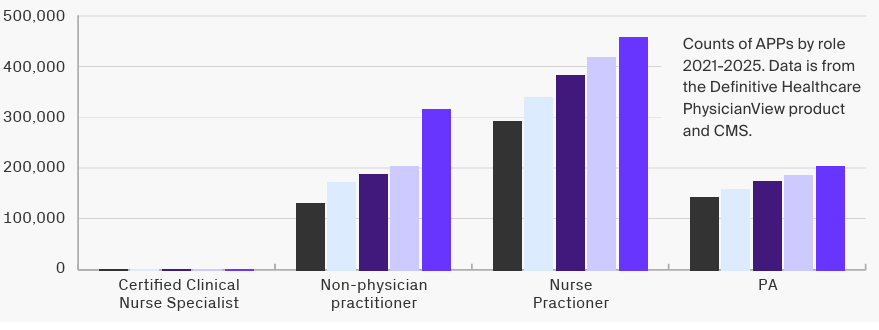
Definitive Healthcare data shows the number of advanced practice providers (APPs) grew 71% between 2021 and 2025. APPs, including nurse practitioners (NPs), clinical nurse specialists, physician assistants, and other non-physician practitioners, now represent more than 40% of care providers in U.S. physician practices. As physician availability becomes more constrained, APPs can help organizations extend care beyond hospitals and into outpatient and community-based settings.
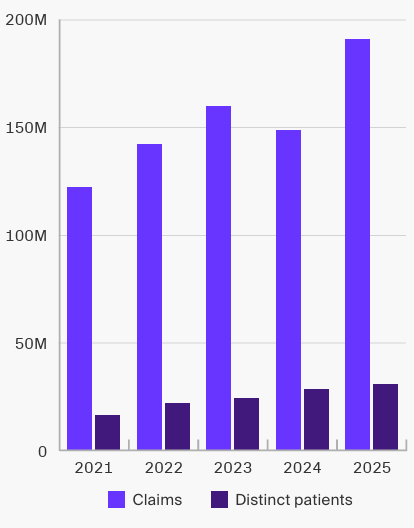
This also extends to support the growing demand for at-home care. Since the passage of the CARES Act in 2020, NPs, clinical nurse specialists, and physician assistants have been permitted to certify, establish, and review home health plans. Our data shows home health claims increased 56% from 2021 through 2025, while the number of distinct patients receiving home health services increased nearly 90%.
Home Health Care Activity 2021 - 2025
As the provider mix evolves, healthcare leaders will need to reconsider how they deploy their limited clinical resources. Not every patient interaction needs to happen at a hospital or require an in-person visit. Understanding which providers are needed, where they’re needed, and how to most effectively support them will be critical moving forward.
Distributed care requires a connected view of the healthcare landscape
Distributed care can make healthcare delivery more accessible, flexible, and convenient for patients. It also makes care more complex, too.
As care becomes dispersed across hospitals, ASCs, physician offices, retail clinics, virtual channels, and patients’ homes, the more important coordination becomes. A single patient journey may cross several of these settings, sometimes involving different organizations, ownership structures, care teams, and data systems along the way. And leaders will have more relationships, touchpoints, technologies, and resources to manage.
Leaders can also expect operational complexity to grow. Staffing needs may vary by facility type, geographic location, and patient population. Supply chains must be reconsidered to support more decentralized locations, and technology systems may need to communicate across organizations.
To find success, healthcare leaders need to ask a new set of questions:
- Where are certain procedures moving from inpatient to outpatient settings?
- Which physicians are performing them, and at which facilities?
- How are hospitals, ASCs, physician offices, and other organizations affiliated or connected?
- Which markets are underserved?
- Where are new opportunities or risks emerging?
The same need for visibility matters for the organizations that support healthcare. Leaders need insights that give them the clarity to size their addressable markets, move faster, target smarter, and achieve their business goals, regardless of industry.
You can get the full picture of patient and provider activity across the healthcare landscape with claims data and referral and affiliation intelligence. Claims data shows what is happening across the market, including which diagnoses and procedures are occurring, where care is being delivered, and how utilization is changing over time.
Referral data adds another layer by showing how patients move between providers and facilities, helping leaders identify influential physicians, strong referral relationships, network leakage, and gaps in care. Affiliation data provides the context behind those relationships by revealing how physicians, facilities, health systems, and other organizations are connected.
Together, these datasets can help leaders understand not only where care is happening and who is delivering it, but how patients and providers move through the broader healthcare network. That visibility can support decisions around market expansion, service-line strategy, physician alignment, network development, and resource allocation.
Want a clearer view of the healthcare networks and facilities in your market? Book a demo with Definitive Healthcare.

You might also be interested in...