Healthcare demand is shifting—from inpatient to outpatient, from doctors’ offices to patients’ homes—and growing in major markets and underserved regions alike.
Whether your organization is prepared to keep up with that demand and seize emerging growth opportunities depends largely on your ability to rapidly identify and act on trends as they develop.
Our webinar, “Follow the patient: Where healthcare demand is headed next,” examines the critical trends in care delivery shaping tomorrow’s market as well as the demand signals that organizations can use to build smarter, more effective growth strategies around those trends.
It’s worth checking out the webinar replay for detailed analysis and unique insights from Kevin Meek, VP of Advisory Services for The Haskell Company, as well as Definitive Healthcare’s Troy Hanninen, Solution Consulting Manager, and Kevin Dubuc, Senior Product Marketing Manager.
But if you’re just looking for a high-level recap of the webinar? Keep reading.
Get the lay of the healthcare landscape
The healthcare map is being redrawn all the time, but in recent years, a handful of key trends are guiding those updates:
Outpatient care continues to expand
Driven by shifting patient demand, technological advancements, and cost incentives, health systems are continuing to invest in ambulatory surgery centers, retail clinics, and other outpatient facilities. Providers, device manufacturers, and other organizations selling into healthcare can find lucrative opportunities outside hospital walls, if they know where to look.
Consumers put a premium on convenience
As consumers increasingly seek personalized, accessible, and expedient shopping experiences, healthcare providers can win—and keep—more business by delivering convenient, seamlessly integrated patient experiences. From onboarding and office visits to telecare and follow-up, there are plenty of points along the patient journey to reduce friction. The right data can reveal the most lucrative places to focus.
Provider organizations face margin pressure
The average health system in 2026 faces negative operating margins, mostly due to declining revenue. For many providers, this means tightening their wallets, cutting investments in lower-performing service lines, and maximizing the impact of existing resources through strategic staffing and retention efforts. Medical claims and consumer data offer insight into where resources can be divested or reinforced.
Systems are reevaluating facility footprints
With care increasingly shifting to outpatient, virtual, and in-home settings, many health systems are revisiting their approach to real estate. And with workforce supply simply unable to keep pace with patient demand, increasing inpatient bed count is no longer a clear path to meeting that demand.
Today, successful health systems are increasing capacity by spreading care management across interconnected networks of ambulatory facilities, micro hospitals, and medical office buildings using technology and intelligent care coordination. While that might mean more square footage, it often doesn’t mean expanding legacy hospitals—and may even result in the decommissioning of duplicative facilities.
New markets are becoming increasingly attractive
Accelerating merger and acquisition activity throughout healthcare is making it harder for new entrants to compete in major markets and driving development further into the suburbs and rural communities. Evolving reimbursement policies around remote, virtual, and in-home care are also opening new avenues for revenue in underserved areas.
Healthcare’s new frontiers aren’t just geographical. Market demand for weight loss treatments like GLP-1 drugs, behavioral healthcare, and precision medicine present providers with opportunities for service line expansion and revenue growth.
Answer the right questions with the right data
The organizations leading the healthcare field know how to balance situational awareness with a strategic outlook that accommodates an array of likely outcomes.
To do this, you’ll need a current, high-resolution, and multi-dimensional understanding of the market. That means building a data-driven growth strategy that answers four questions:
- Where is care happening today?
- Where will demand emerge tomorrow?
- Who controls access to patients?
- What investments are most likely to succeed?
Answering those questions requires you to understand the demand signals within medical claims and consumer data.
Medical claims data reveals what’s actually happening
Medical claims data—including diagnosis, prescription, and procedural claims information—is a powerful source of healthcare intelligence, when analyzed appropriately.
Medical claims contain details about where and at which facilities care is occurring, which organizations and individuals are delivering it, what specialties they represent, and who is receiving that care (in broad, deidentified terms, such as patient age, gender, and payor affiliation). Claims also offer insight into the modalities, technologies, and medicines being used.
Paired with the right analytical tools and systems, claims data can signal:
- Procedure growth trends
- Service line migration patterns
- Outpatient expansion opportunities—or competitors’ expansion efforts
- Shifts in market share
- Patient travel patterns
Broadly speaking, organizations operating in healthcare can use medical claims to determine where demand for specific procedures or therapies is occurring.
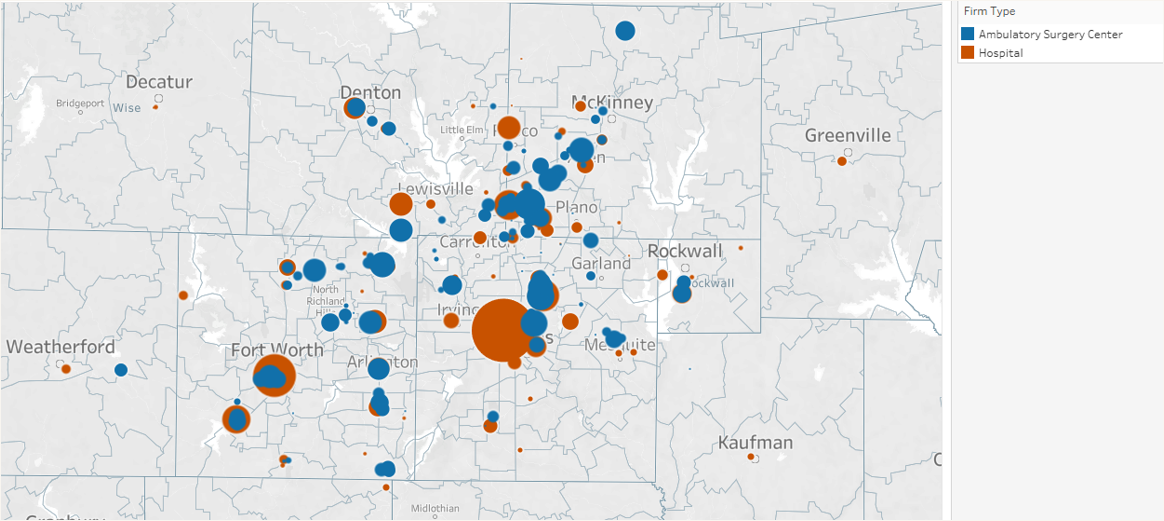
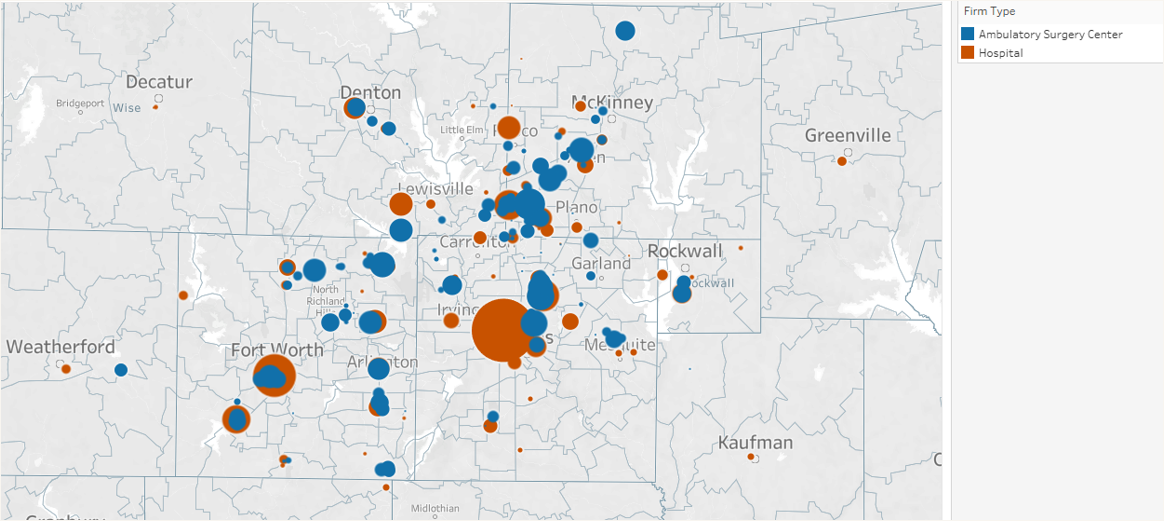
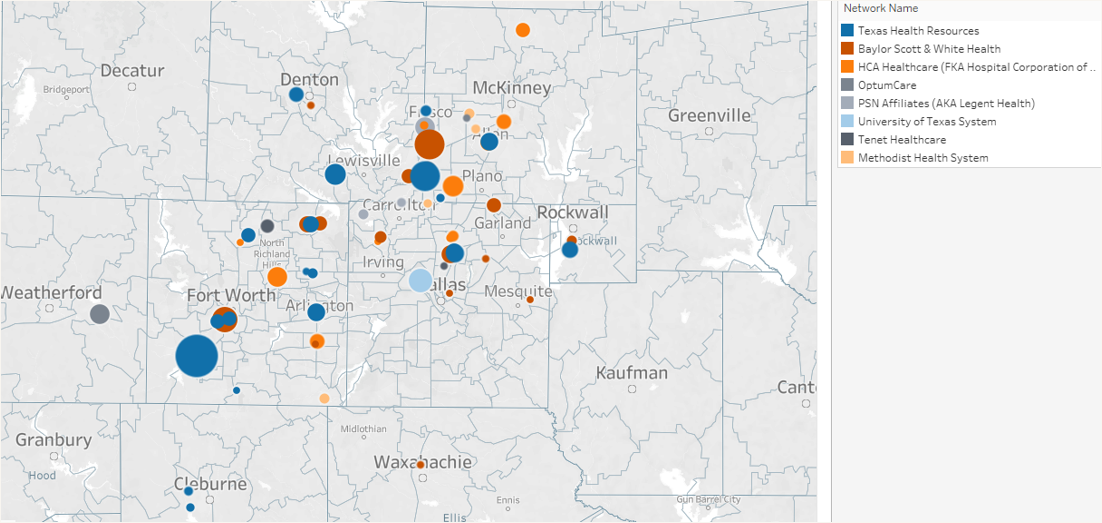
For example, the map below uses claims data to identify where surgical demand is being served in the Dallas, Texas CBSA.